
The Difference Between B2B and B2C Data: What You Need to Know
From lead generation to sales, knowing the difference between B2B and B2C data is critical. Learn how to use each type for smarter targeting and higher conversions.
Introduction
In business, data is the language of expansion that everyone can understand. It dictates every advertising campaign, directs every sale, and defines every strategic move. Yet, not all data are equal. The data you must use to sell a new software package to a Fortune 500 firm is inherently dissimilar from the data used to sell a pair of sneakers to a teenager. And this difference is at the center of your whole go-to-market strategy: the all-important distinction between Business-to-Business (B2B) and Business-to-Customer (B2C) data.
Comprehending this chasm is not just an intellectual exercise; it's the foundation of successful targeting, effective expenditure, and long-term expansion. Employing the incorrect form of data is attempting to chart a city with a nautical map—the tools are redundant because the terrain is fundamentally different. This piece will analyze the distinct nature of B2B and B2C data, examine the profound significance of the differences, and shed light on why winning in the complex B2B environment requires a specialized data partner.
🌐 The B2C World: All About the Individual
Fundamentally, B2C data is about knowing one person as a shopper. The aim is to create an in-depth, individual picture to anticipate and guide their buying behavior. This universe of data is huge and diverse, usually broken down into three broad categories:
Demographic Data: This is the "who" of the shopper profile. It consists of building block, quantifiable attributes such as:
- Age and Gender
- Geographic Location (Country, City, Zip Code)
- Income Level
- Education Level
- Marital and Family Status (married with children)
Psychographic Data: The "why" of consumer behavior. It explores the more abstract elements of an individual's lifestyle and personality, such as:
- Interests and Hobbies (hiking, gaming, cooking, for example)
- Values, Beliefs, and Opinions
- Lifestyle Choices (ecologically oriented, luxury seeking)
- Social Media Activity and Affinities
Behavior Data: This is the "what" and "how" of consumer interaction. It follows concrete interactions and history of previous behavior to inform future behavior, like:
- Purchase History and Average Order Value
- Website Browse Patterns and Cart Abandonment
- Brand Interaction and Loyalty Program Membership
- Email Open and Click-Through Rates
For a B2C business, success is about stringing all these together to provide a personalized experience. The sales cycle tends to be short and emotion-driven. A purchase decision to buy a new coat or book a holiday is typically made by an individual based on desire, necessity, or whim. The data hence provides for targeted social advertising, delivery of personal discount coupons, and product recommendations derived from past browse history. The size is enormous—billions of individual consumers—but the attention is still focused on the individual, single, personal identity.
📊 The Landscape of B2B Data: A Focus on the Organization
When your customer is a business, the data landscape changes entirely. B2B data isn't about a person's personal tastes; it's about an organization's business requirements and the particular job professionals are doing within it. The objective is to know a company as a potential customer and the important people in the company who can advocate for, influence, and sign off a buy. That data is much richer and deeper.
Firmographic Information: The "demographics" of a firm, giving an underlying snapshot of the firm itself. The most important pieces of information are:
- Industry: The exact sector the firm is in (usually designated by NAICS or SIC codes).
- Company Size: Either measured by annual revenue or number of employees.
- Geographic Location: The headquarters address and other key offices.
- Company Growth Path and Age: Is it a startup with high growth or a legacy company?
Technographic Information: This is very important in today's online age. It lists the technology stack that an organization employs and thereby the possible needs and integration points. This may involve:
- CRM tools (e.g., Salesforce, HubSpot)
- Marketing automation platforms
- Cloud service providers (e.g., AWS, Azure)
- Programming languages utilized by their development team
Professional Contact Information & Titles: This is arguably the most important layer. Knowing the company isn't sufficient, you need to know the appropriate people at that company. This is:
- Key Personnel Names
- Specific Titles (e.g., VP of Engineering, Director of Marketing, Chief Financial Officer)
- Confirmed Work Email Addresses and Direct Phone Numbers
- Professional Profiles (e.g., LinkedIn)
Buying Signals: This is high-end B2B intelligence indicating that a company may be in the market for a solution. These are timely alerts, such as recent funding rounds, announcements of expansion into new geographies, or hiring in a specific department.
The B2B sales process is lengthy and decision-based, and typically includes a "buying committee" of several stakeholders. A new accounting software purchase, for instance, may need approval from the Head of Finance, the IT Director, and the CEO. The information must be robust enough to track this intricate network of influence and address professional pain points—such as efficiency, ROI, and risk reduction—that inform business decisions.
🔹 Five Fundamental Differences That Characterize Your Strategy
The differences between B2B and B2C data establish five key divergences that have significant implications for any company:
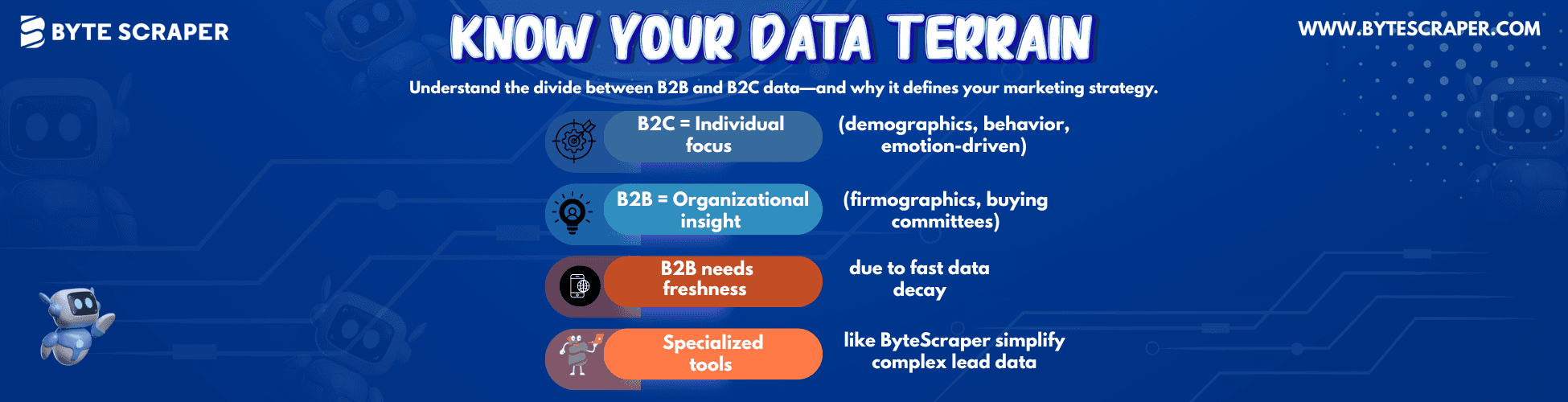
- Scale vs. Complexity: B2C data is of enormous scale, handling millions or even billions of relatively straightforward individual profiles. B2B data is of a lesser scale (there are many fewer companies than individuals), but each data point is exponentially more complicated, interrelating several professional contacts, departments, and firmographic layers into one organizational profile.
- The Decision-Making Unit: The B2C decision-maker is usually an individual. The B2B decision-making unit is a team. Your data needs to target not only one contact, but the whole group of influencers, champions, and spenders responsible for a purchase.
- Data Source and Volatility: B2C data is typically gathered through direct sign-ups by consumers and automated monitoring. B2B data is notoriously volatile and has a short shelf life—people change jobs at an astonishing rate, companies are acquired, and roles are redefined. This "data decay" renders B2B data susceptible to constant, intense re-verification, making it valuable.
- The Nature of Personalization: With B2C, personalization is all about the person: "Hi John, we think you'll love these running shoes." With B2B, personalization is all about professional context and relevance: "As a Director of Logistics in the manufacturing sector, optimizing your supply chain is probably a top priority."
- Privacy and Compliance: Although consumer data privacy is regulated by legislation such as GDPR and CCPA, B2B data has a different policy generally tied to "legitimate interest" for business communication purposes. The emphasis is on ensuring that contact details are for a professional position at a business, rather than an individual's private information.
🚀 The Urgent Requirement for an Expert B2B Data Partner
With these deep distinctions in mind, it should become apparent why applying B2C tools or techniques to B2B lead generation is bound to fail. It's a futile exercise. You can't locate the VP of Operations at a mid-sized manufacturing company using the same data that identifies 25-year-old sneakerheads.
This is precisely the problem that a specialized B2B data provider such as ByteScraper is engineered to address.
Trying to manually assemble, scrub, and continuously validate the intricate network of B2B information is a vast resource sink—time, money, and personnel that could instead be devoted to real selling and promoting.
ByteScraper bears this weight by having as its sole task delivering the organized, structured, and validated B2B information companies require for success. Our platform enables you to:
- ✅ Get Access to Rich Firmographic Data: Get companies instantly by industry, size, and location.
- ✅ Use Granular Filtering: Target precise job titles so that you are speaking to genuine decision-makers.
- ✅ Have Confidence in Verified Data: Our efforts to offer audited and correct lists eliminate the issue of data decay, preventing your teams from wasting time pursuing invalid leads.
By employing a dedicated service, you cut out the noise and the complexity and get direct access to clean, targeted, and actionable business leads.
🔢 Conclusion: Pick the Right Tool for the Task
The B2B vs. B2C data distinction is the building block on which your whole commercial strategy is constructed. It determines your messaging, marketing channels, sales process, and ultimately, your growth potential. Whereas B2C data explores the private and affective universe of the individual shopper, B2B data maps the labyrinthine, rational, and role-defined universe of the company. To succeed in that universe, you require a toolset designed to meet its distinct challenges. For any serious business committed to B2B expansion, investing in a reputable, dedicated B2B data provider is not a discretionary item—it's essential.