
Is Big B2B Data Still Valuable in the Age of First‑Party Data?
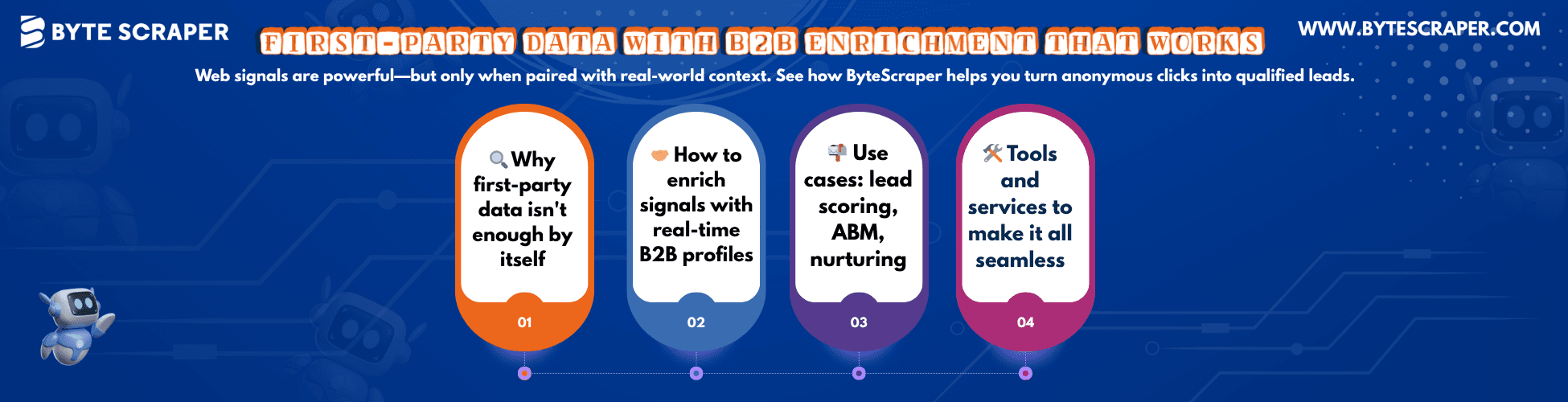
Web signals are powerful—but only when paired with real-world context. ByteScraper helps turn anonymous clicks into qualified leads.
📢Introduction
We’ve all heard it: “First-party data is king.”
It’s the phrase echoing through every marketing blog, conference stage, and Zoom strategy call. And for good reason—first-party data is accurate, permission-based, and rich with intent. As cookies crumble and privacy regulations tighten, it’s clear that brands must lean into the data they collect directly from users.
But here’s the twist no one talks about enough: first-party data is powerful—but it’s not complete.
You know someone downloaded your whitepaper. Great. But who are they?
Are they an intern just curious about your industry—or the VP of your dream account, ready to buy?
This is where big B2B data steps back into the spotlight—not as a rival to first-party data, but as its perfect complement. When combined, the two unlock deeper insight, sharper personalization, and faster revenue.
👑 Why First-Party Data Deserves the Crown
Let’s give credit where it’s due. First-party data is the foundation of modern marketing. It tells you exactly who’s engaging with your content—and how:
- 🔍 A visitor checks your pricing page three times in a week
- 📬 Someone signs up for your newsletter
- 🛒 A customer purchases a specific product
This is data that’s unique to your business. It’s permission-based, behavior-rich, and packed with buying signals. But it has a blind spot:
First-party data tells you what someone is doing, not who they are.
And that’s a problem when you’re trying to qualify leads, personalize messaging, or build an account-based strategy.
🔍 The Gap: Where First-Party Data Falls Short
Say someone downloads your "Inventory Optimization Guide." Their email is [email protected]. Cool, Dave seems interested—but you don’t know if he’s a college student or the Director of Supply Chain at a Fortune 100 company.
You’re left wondering:
- Who is this person, really?
- What company do they work for?
- Are they the decision-maker—or just a curious researcher?
Without context, you can’t qualify or prioritize. You’re sitting on a good signal—but it’s incomplete.
🤝 The Power of Enrichment: First-Party Meets B2B Data
This is where real-time B2B data changes everything.
Let’s go back to Cool Dave. With ByteScraper’s enrichment layer, you can instantly transform that one email into a complete business profile:
- 👤 Name: David Miller
- 💼 Job Title: VP of Logistics
- 🏢 Company: Global Shipping Inc.
- 👥 Team Size: 5,000+ employees
- 🌐 Industry: Transportation & Logistics
Now you’re not guessing—you’re acting on qualified, real-world insight.
ByteScraper connects your first-party identifiers (emails, domains, form fills) with a massive database of publicly sourced B2B intelligence—refreshed in real time using advanced web scraping.
This fusion doesn’t replace your data—it amplifies it.
🚀 Use Cases: What You Can Do With Enriched Signals
Here’s how combining first-party and third-party data transforms your sales and marketing strategy:
⚙️ 1. Smarter Lead Scoring
Don’t treat all leads the same. A form submission from a university student and one from a Fortune 500 executive shouldn’t carry equal weight.
With enrichment, your lead scoring engine can dynamically assign value based on job title, company size, or industry relevance.
Example:
- ❌ +10 points: Dave downloads a whitepaper
- ✅ +50 points: Dave is VP of Logistics at a $1B company → auto-flag as sales-qualified
📬 2. Personalized Nurturing at Scale
Let’s say a visitor reads your blog post on inventory software. Your system recognizes them as part of the e-commerce industry, thanks to enrichment.
Instead of sending a generic follow-up, you drop them into a tailored email sequence that highlights how you’ve helped e-commerce brands with similar pain points.
Relevance = Results. And it’s only possible when you know who you're talking to.
🧠 3. Unlock Hidden ABM Opportunities
A bunch of visitors sign up for your content using personal emails—@gmail.com, @yahoo.com, @aol.com. On the surface, they look like unrelated leads.
But enrichment reveals they all work at Global Shipping Inc.
Now you’re not just looking at 10 random contacts.
You’re looking at a buying committee from a high-value account. That’s an instant ABM trigger.
🛠 How ByteScraper Makes This Easy
Enrichment sounds complex. But ByteScraper makes it seamless:
- 🎯 You define the signals (emails, domains, firm names)
- 📡 ByteScraper scrapes real-time public data to append missing details (job title, industry, company size, location)
- 📥 You get structured, ready-to-use data via API, spreadsheet, or direct CRM sync
No coding. No guesswork. Just real-time insight—delivered.
✅ Conclusion: First-Party + B2B = Future-Proof Growth
So, is big B2B data still relevant?
Absolutely—and even more so when paired with first-party intelligence.
- First-party data tells you someone is interested.
- B2B enrichment tells you why you should care.
Together, they power lead qualification, personalization, segmentation, ABM, and more.
In today’s landscape, the companies winning aren’t choosing between first-party and third-party data—they’re marrying the two to fuel smarter, faster growth.
💬 Frequently Asked Questions (FAQs)
1. Isn’t first-party data more trustworthy than third-party data?
Yes, but third-party B2B data isn’t trying to replace it—it adds context. The key is using trusted, real-time sources like ByteScraper, not outdated lists.
2. Can’t I ask for more information in my forms?
You could—but longer forms kill conversions. Enrichment gives you the same insights without extra friction.
3. How fresh is ByteScraper’s data? provides the same insights without added
All data is sourced and updated in real time via public web scraping: no stale databases, no recycled lists.
4. Is enrichment only for big teams with CRMs?
Not at all. ByteScraper works with startups and enterprise teams alike, supporting formats such as CSV, Sheets, and API, depending on your workflow.
5. How do I get started with ByteScraper?
Just tell us the signals you already collect (emails, domains, lead forms), and we’ll enrich them with high-quality B2B data—no setup headaches.