
How to Build B2B Lead Lists for Any Industry or Location
Learn how to build targeted B2B lead lists for any industry or location using smart strategies, tools, and data sources. Perfect for marketers, agencies, and sales teams.
📍Introduction
In B2B sales and marketing, your lead list is not merely a launchpad; it is the whole basis upon which your success is established. A painstakingly built list of qualified leads can drive explosive growth, while a shoddily compiled one can result in squandered resources, demoralized staff, and flat revenues. The quality of your approach is proportional to the quality of the information you start with.
Most companies approach list building as a piecemeal effort, pieced together from various sources without strategic planning. Constructing a high-performing B2B lead list for any niche or region, though, is a methodical effort. It needs to start with a clear vision of your target, an organized strategy for data gathering, and the right tools to maintain accuracy and efficiency. This book will take you through the key steps to create high-powered, focused lead lists that will drive your sales and marketing campaigns.
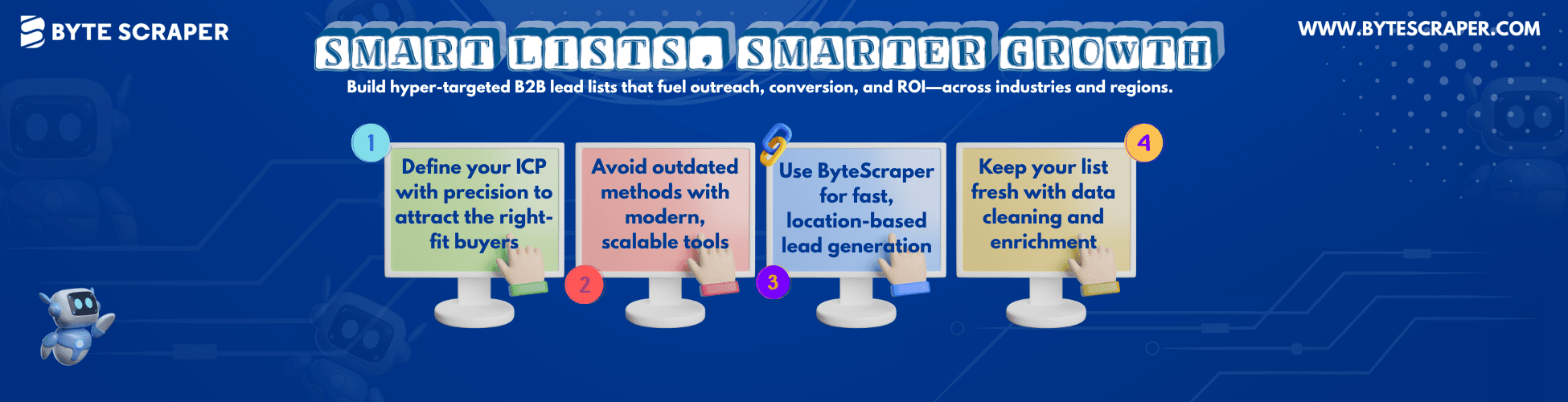
🧠 Step 1: Define Your Ideal Customer Profile (ICP) with Precision
You can't identify your ideal customers until you're clear on who they are. An Ideal Customer Profile (ICP) is a rich, semi-fictional character description of the ideal company to purchase your product or service. This is much more than a loose sense, such as "we sell to tech firms." A solid ICP is constructed from granular data points.
A) Firmographics: These are the fundamental qualities of the firm.
📌 Industry: Be specific. Don't say "manufacturing." Say "medical device manufacturing" or "aerospace parts manufacturing." If possible, use industry classification codes such as NAICS or SIC.
📌 Location: Specify the geographic targets. Do you want to target businesses in a particular country, state, city, or even a specific zip code?
📌 Size of Company: Is your solution ideal for small companies (1–50 employees), mid-market firms (51–1000 employees), or large corporations (1000+ employees)? Clarify this by the number of employees and/or annual revenues.
📌 Structure of Company: Are you addressing privately held firms, publicly traded companies, or non-profits?
B) Technographics: This is finding what technology stack your ideal customers are working on. This is very important for a software company, for instance. If your product works perfectly with Salesforce as a CRM, target those companies that utilize Salesforce as their CRM.
C) Buying Signals & Pain Points: What makes a company require your solution? Are they adding staff quickly in a certain department? Did they raise another round of funds? Are they growing to a new office? Knowing these signals allows you to time your approach flawlessly. Also, know their typical pain points—what issues does your product alleviate for them?
When you do have a crystal-clear ICP, then each step in the list-building process becomes more targeted and effective.
🔍 Step 2: Sourcing Your Data – The Traditional Methods (and Their Pitfalls)
Now that you have defined your ICP, you need to locate companies and contacts matching it. Historically, this has been achieved using a combination of manual and semi-automated techniques:
📇 Manual Prospecting (LinkedIn Sales Navigator): LinkedIn is an excellent tool for finding professionals at particular companies and industries. You can search by job title, company, location, and so on. But this is extremely time-consuming. Discovering people individually, verifying they are in the proper role, and then attempting to uncover their contact information is a tedious manual process.
📇 Industry Associations and Directories: Most industries have their industry associations and online directories (e.g., ThomasNet for manufacturing). They can be a good place to find company names, but often do not include direct contact information for decision-makers, and the information is outdated.
📇 Trade Shows and Conferences: Attendee lists from industry conferences are a potential goldmine of appropriate contacts. They can be hard to get access to and costly, but only drop into your lap a few times a year.
Although these approaches can return some gain, they have one major drawback in common:
⚠️ Time-Consuming: Manual prospecting is a labor-intensive endeavor that takes your sales staff away from their true calling: selling.
⚠️ Susceptible to Inaccuracy: Online information may be old. Employees move, and corporate information shifts. Manually confirming every piece of information is virtually impossible at scale.
⚠️ Inaccurate Data: You may find a name and an organization, but not a confirmed email address or direct line, rendering the lead useless for follow-up.
These issues underscore the importance of a more efficient, dependable, and scalable means of data sourcing/
⚙️ Step 3: The Contemporary Solution – Utilizing a Specialist B2B Data Provider
The best solution to constructing high-value B2B lead lists in any industry or geographical region is to join forces with a specialist B2B data provider. By doing so, list building becomes an automated process, rather than a data-intensive one.
Tools like ByteScraper are specifically designed to address the shortcomings of traditional prospecting methods. Rather than having you scour for information, ByteScraper gives you straight access to big, pre-screened, and structured databases of business information that you may sift through to identify precisely what your ICP is looking for.
Here's how this process transforms the process:
- 🏢 Choose Your Industry: The initial step on a site like ByteScraper is to select your desired industry from an exhaustive list. If you need information on "Restaurants," "Construction" contractors, "Real Estate Agencies," or "Medical Clinics," the information is pre-categorized for you.
- 🌍 Use Geographic Filters: This is where the "any location" need is a breeze. You can instantly filter the master list of an industry by country, state, or even city. Do you require a list of law offices in California? Or car repair facilities in Chicago? You can create this particular list in seconds, not weeks.
- 📩 Instant Access to Rich, Verified Data: After applying your filters, you don't receive a list of company names. You receive a rich dataset containing:
- Company Name and Address
- Verified Email Addresses: Essential for email marketing campaigns
- Verified Phone Numbers: The key to successful cold calling campaigns
- Size of Records Available: You are aware of the exact number of your potential market
Having a provider like ByteScraper enables you to bypass the most tedious and error-prone aspects of list building. The data is already gathered, sorted, and verified, so you can create a list that precisely meets your ICP's needs in just a matter of clicks. This leaves your team free to concentrate on strategy, personalization, and outreach.
🎯 Step 4: Segmenting Your List for Targeted Campaigns
Once you have acquired your master lead list from a source like ByteScraper, the work isn't over. To maximize your outreach effectiveness, you must segment this list into smaller, more targeted groups. A one-size-fits-all message will not resonate.
Segment your list based on the ICP criteria you defined in Step 1:
🗺️ By Location: Create separate campaigns for different states or regions to add a touch of local relevance.
🏢 By Company Size: A 10-person startup has different pain points than a 500-person company. Tailor your message for each.
🧑💼 By Job Title: The message to a CFO needs to be around ROI and cost savings, while the message to a CTO needs to be about technical advantage and integration.
Segmentation enables you to customize your outreach at scale, significantly boosting your response rates and conversion potential.
🔄 Step 5: Keeping and Enriching Your List
Your lead list is not a stagnant asset, but a living database that needs constant maintenance. As stated, data decay is an issue that exists in the B2B environment. To ensure your list remains worth its while, you need to have a system for:
🧹 Regular Cleaning: Consistently check emails and phone numbers to eliminate contacts that are no longer working.
🔍 Enrichment: Continuously add new data points to your existing records. For example, you might enrich your list with technographic data or recent buying signals as you uncover them.
🔄 Updating: When you learn that a contact has changed jobs or a company has been acquired, update your records immediately.
A well-cared-for lead list is a valuable, long-term asset that will keep creating value for your company for many years to come.
✅ Conclusion: From Sweat to Strategic Edge
Creating a powerful B2B lead list is the first and most crucial step in achieving your revenue objectives. Though older methods have their utility, they are riddled with inefficiencies and inaccuracies that can cripple even the most skilled sales team.
By taking a strategic, five-step approach—beginning with a clear ICP and leveraging the strength of a niche-based B2B data provider like ByteScraper—you can transform list building from a thorny, time-consuming chore into a valuable competitive differentiator. This cutting-edge method enables you to create highly focused, accurate, and scalable lead lists for any industry or geography, giving your team the high-quality fuel they need to generate real, sustainable growth.
❓FAQs
Q 1. What exactly is a B2B lead list, and why is it so important?
=> A B2B lead list is a curated collection of potential business prospects—companies or professionals who are likely to be interested in your product or service. It's more than just names and emails—it's the foundation of your entire outreach strategy. A great list provides your sales and marketing teams with the direction and focus they need to convert more effectively and waste less time.
Q 2. How do I know if my lead list is targeting the right people?
=> It all starts with defining your Ideal Customer Profile (ICP). If you're buying generic data or scraping without a clear strategy, you’re likely missing the mark. A strong ICP includes firmographics, technographics, location, company size, and even pain points. The more precise your targeting, the better your conversion rates will be.
Q 3. Can't I use LinkedIn or online directories to build my list of leads?
=> You can—but be ready to lose a lot of hours. Manual prospecting through LinkedIn, directories, or trade show attendee lists is slow, outdated, and often inaccurate. Emails go stale, phone numbers change, and the data isn’t always verified. If you're serious about scaling, tools like ByteScraper offer a significantly faster and more accurate alternative.
Q 4. How does ByteScraper help me build a better lead list?
=> ByteScraper takes the grunt work out of lead list building. You choose the industry, location, and filters, and we deliver verified emails, phone numbers, company details, and more—all cleaned, structured, and ready to use. With over 2,000 projects completed for more than 1,000 clients, we’ve developed lead list solutions that work.
Q 5. How can I prevent my lead list from becoming stale over time?
=> Lead data decays faster than you think—people change roles, companies shift direction, and contact details expire. To keep your list fresh, schedule regular cleaning, enrichment, and updates. At ByteScraper, we also offer data refresh and enrichment services to keep your campaigns sharp and your ROI strong.