
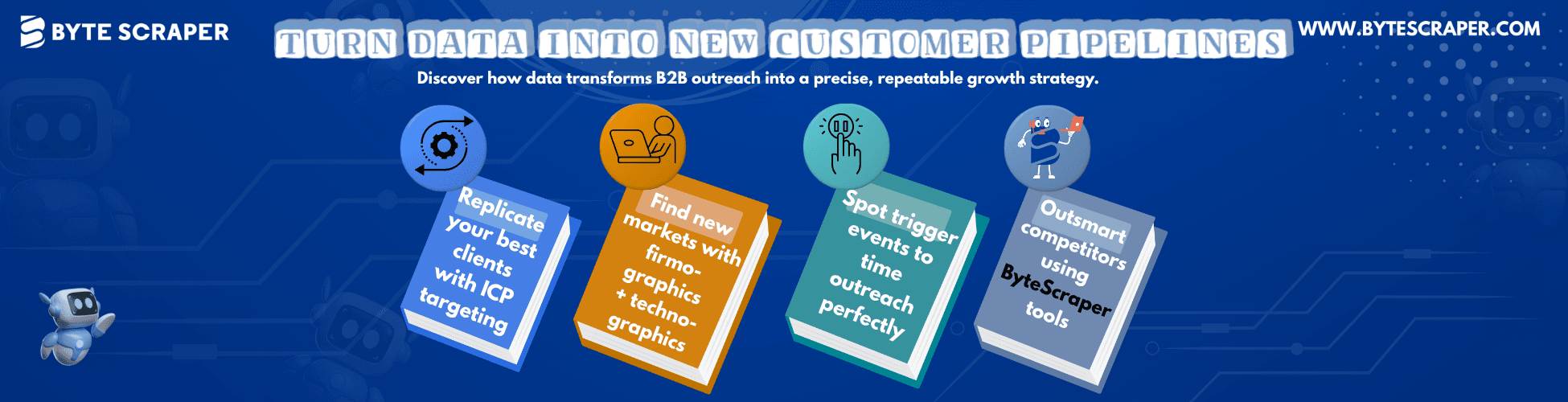
How Smart B2B Companies Use Data to Win New Customers
Discover how B2B companies turn raw data into new customers—by targeting the right leads, timing outreach perfectly, and personalizing every pitch.
Introduction
In today's competitive B2B environment, hoping for customers to come to you is a recipe for standing still. Growth necessitates proactive, strategic, and data-driven client acquisition. Today's B2B businesses are no longer merely selling; they are data experts, applying data to locate, target, and interact with their next best customers with unprecedented accuracy.
Data is the compass that points to new opportunities, uncovering untapped markets and high-potential prospects that would otherwise go unnoticed. It enables businesses to break free from guesswork and create a predictable pipeline of new customers. This guide examines the advanced techniques B2B organizations employ to transform raw data into a potent engine for client acquisition.
🎯 Strategy 1: Ideal Customer Profile (ICP) Replication
One of the most effective methods for acquiring new clients is to target businesses that resemble your current top clients. Your most profitable, happiest clients are not an accident; they all have something in common. ICP duplication involves trying to unlock those attributes and identifying other companies similar to them.
The Process:
- Study Your Best Clients: Begin by creating a list of your 10–20 best clients. "Best" might be defined by revenue, profitability, ease of working with them, or long-term commitment.
- Enhance Their Data: Develop a comprehensive data profile for each client. What is their industry (NAICS/SIC code)? How many workers do they employ? What's their annual revenue? Where are they geographically located? What technologies do they use (technographics)?
- Identify Commonalities: Look for trends among your top clients. Do you observe that 70% of them belong to the logistics sector, employ 100–500 people, and utilize Microsoft Azure? This is your ideal customer's data signature.
- Find Look-Alike Companies: This is where a strong B2B data source becomes essential. With a tool such as ByteScraper, you can take these individual data points and create a new list of "look-alike" businesses. You can screen a massive database by the precise industry, employee size, and locale that defines your most valued clients. With this technique, you can cease looking for needles in haystacks and begin looking in a stack that contains virtually nothing but needles.
🌍 Strategy 2: Market Expansion and Diversification
Data can shed light on new geographies and industries where expansion is possible. One company may be highly successful in one vertical or geography but have no idea of the same opportunity elsewhere.
The Process:
- Hypothesize Adjacencies: Begin with your core market. If you sell effectively to dental offices, what are adjacent markets? Maybe veterinary offices, optometrists' offices, or physical therapy offices have similar business requirements.
- Quantify the Opportunity: You must understand the size of a new market before investing in it. This is an essential fact-driven step. There's a tool such as ByteScraper that will immediately inform you of the size of these potential new markets. You can immediately see that there are, for example, 60,000 veterinary clinics in the United States. This information confirms the market's viability.
- Examine Geographic Potential: Utilize data to identify areas where your target industry is concentrated, yet your organization has minimal or no presence. Screening a national listing of your target industry by state or city can unveil untapped "greenfield" territories, offering a precise blueprint for your sales expansion initiatives.
- Construct a Starter List: When you prove a new market, you can immediately purchase a starter list of high-quality prospects for that new vertical or region, allowing your team to test the waters with a focused pilot campaign.
⏱️ Strategy 3: Trigger Event-Based Selling
The ideal time to contact a potential customer is when they urgently need your solution. Trigger events refer to particular events that induce the need. A data-driven process enables you to track these indicators and get in touch at the right time.
Typical B2B Trigger Events:
- New Executive Hires: A new VP Sales or Chief Marketing Officer will typically be given a mandate to change and a budget to make it happen within their first 3–6 months.
- Company Funding Rounds: A company that has recently received Series A, B, or C funding has new capital and is under pressure to invest in growth and expand operations.
- Expansion Announcements: When a company opens a new office, factory, or enters a new country, it will require a range of new services and technologies.
- Mergers and Acquisitions: M&A activity creates significant operational and technological disruption, often opening the door for new vendors to solve integration challenges.
- Hiring Spurts: A company that aggressively hires software developers or salespeople is a strong indication that it is expanding and likely investing in underlying tools and infrastructure.
Manual tracking of these signals is not possible. B2B businesses employ news alerts, financial information services, and industry-specialized data providers that can identify these events and alert sales teams so they can build a highly relevant and timely message, such as "Congratulations on your recent Series B funding! As you expand your sales force, having them have the best data will be imperative."
🥇 Strategy 4: Competitor Conquesting
Your competitors' customers are a treasure trove of potential new business. Information enables you to target and identify these accounts strategically.
The Process:
- Identify Competitor Technologies: With technographic data, you can construct lists of organizations that utilize a competitor's solution. If you're selling a marketing automation platform that outperforms a key competitor, a list of all their customers is your ultimate target list.
- Track for Dissatisfaction: Watch review websites, discussion boards, and social media for indications of dissatisfaction with a competitor. This is a golden opportunity to introduce your solution as a superior option.
- Targeting Expiring Contracts: Although hard to come by, data on contract renewal cycles (usually estimated from the date when an organization initially implemented a technology) can be highly effective, enabling you to reach out at the very moment that a client is reconsidering its choices.
- Leverage Your Unique Selling Proposition (USP): Use facts to identify clients that are an ideal match for what sets you apart in a particular way. If your competitor is a good fit for big companies, but you have a better solution for mid-market companies, use firmographic information from ByteScraper to filter for mid-market companies and address them with messaging that addresses the reasons why your solution is a more suitable choice for a company of their size.
In summary, the best-performing B2B businesses no longer acquire clients at random. They leverage data as a strategic tool to inform their expansion design. By duplicating the profiles of their most valued customers, discovering new markets, responding to timely trigger events, and targeting competitors strategically, they create a strong and predictable client procurement machine. At the center of each of these approaches is access to precise, structured, and filterable B2B data—the raw material that, when wisely used, points the way to your next most valuable client.
🙋♂️ FAQs
Q. What types of data help B2B companies find new customers?
=> Innovative B2B companies utilize a combination of data types, including firmographic, technographic, intent, and trigger-based data. This helps them identify the right targets, time their outreach, and personalize their messaging for better results.
Q. How does ICP (Ideal Customer Profile) targeting work?
=> It starts by analyzing your best existing customers to find patterns in industry, company size, tech stack, and location. Then, you use that data to find lookalike companies that share those attributes—giving you a focused list of high-fit prospects.
Q. Can data help us enter new markets or verticals?
=> Yes. By analyzing adjacent industries or geographic regions using firmographic and technographic data, you can quantify new market opportunities, spot "greenfield" areas, and build pilot outreach campaigns with precision.
Q. What are B2B trigger events and why do they matter?
=> Trigger events are moments of change in a company—like new leadership, funding, expansion, or hiring surges. These signals often indicate that the company is ready to invest or change vendors, making it the ideal time to reach out.
Q. How can I track competitors’ customers for outreach?
=> Using technographic data, you can identify companies using your competitor's tools. Add in intent signals or online reviews indicating dissatisfaction, and you have a list of ready-to-convert accounts for conquesting campaigns.
Q. Why is data timing as crucial as data accuracy?
=> Outreach timing can make or break a deal. Even if you have accurate data, contacting a company too early or too late reduces your chances. Data-driven companies rely on real-time triggers to ensure they're showing up at the right moment.
Q. How does ByteScraper help in customer acquisition?
=> ByteScraper provides accurate, filterable B2B data enriched with firmographics, technographics, and trigger-based insights. Whether you're replicating your best customers or entering a new market, we supply the data that powers more innovative outreach.