
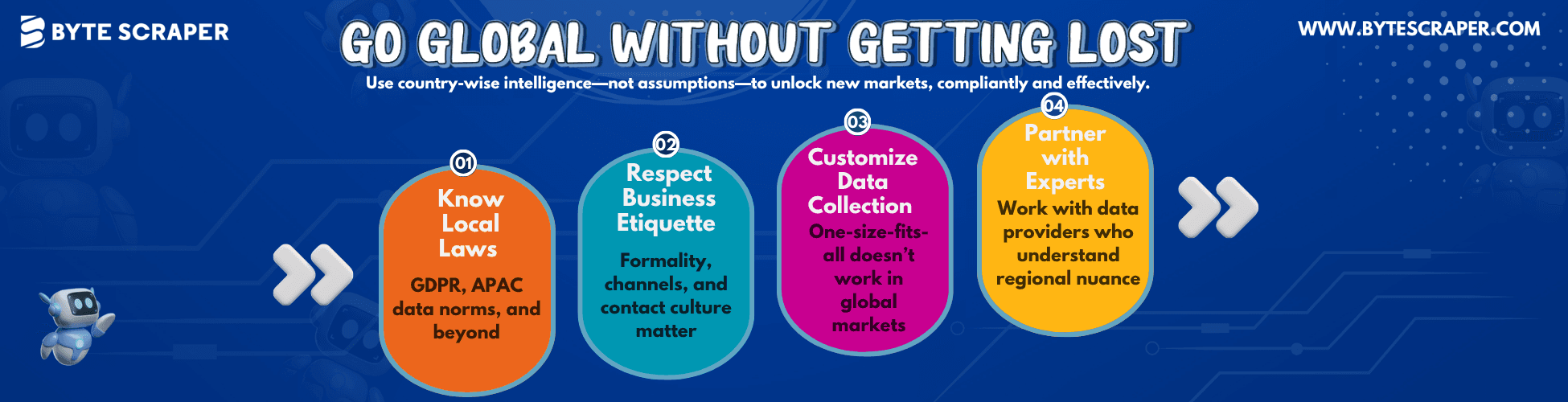
How B2B Data Varies by Country Global Compliance and Outreach Strategies
Global outreach needs more than a contact list. See how ByteScraper helps you expand compliantly with localized, country-specific B2B data.
Introduction
The idea of global reach is exciting—maybe even intoxicating. Thanks to the internet, it feels like you can market your B2B product to a company in Berlin, Tokyo, or São Paulo just as easily as to one in your own neighborhood.
But if you've ever tried to scale internationally, you already know the truth: it’s not that simple.
What works beautifully in the U.S. might flop in Germany. An email campaign that delivers great results in Canada could land you in hot water in France. Why? Because the biggest mistake many businesses make is assuming business data operates the same way everywhere.
It doesn’t.
Every country has its own “data DNA”—a unique combination of regulatory frameworks, cultural expectations, and data structures. Treating global data as a one-size-fits-all asset is a fast track to wasted budgets, compliance headaches, and lost credibility.
⚙️Why Global Data Isn’t One-Size-Fits-All
Three core forces define a country’s data landscape:
⚖️ Regulations: Privacy laws like GDPR and CCPA vary drastically by country.
🤝 Business Culture: Cold emails may be welcome in one place and rude in another.
🗃️ Data Structure: What's public and how it’s structured changes across regions.
The real risk? Relying on U.S.-centric data vendors who gloss over these differences. That approach almost always results in compliance violations or tone-deaf outreach.
🌎 A Tour of Global Data Ecosystems: Challenges & Nuances
North America (USA & Canada)
✅ The Opportunity:
Most transparent and data-rich B2B markets worldwide. Email and phone outreach are accepted norms.
⚠️ The Challenge:
There’s too much data—making quality and relevance the main differentiators.
💡 The Takeaway:
Stand out with high-quality data and hyper-personalized messaging.
Europe (Focus on Germany & GDPR)
✅ The Opportunity:
High economic value and sophisticated markets.
⚠️ The Challenge:
GDPR. Consent and data processing rules are strict, especially in Germany.
💡 The Takeaway:
Compliance isn’t optional. In Germany, calling is often more compliant than emailing.
Formality is vital (e.g., Herr Dr. Schmidt). You’ll need a data partner like ByteScraper, with GDPR-rooted scraping methodology and country-by-country nuance.
Asia-Pacific (Focus on Japan)
✅ The Opportunity:
Immense market potential and growth trajectory.
⚠️ The Challenge:
No universal "APAC playbook." Business in Japan is formal, slow-paced, and relationship-first.
💡 The Takeaway:
Don’t cold-email or cold-call.
Use data to discover targets, then engage through warmer channels (events, LinkedIn, introductions). ByteScraper supports this by identifying the right firms, not just dumping contact info.
🛠️ Building a Winning Global Data Strategy
✅ Prioritize Compliance and Local Expertise
Before targeting a new market, understand its laws. Your provider must clearly explain how they stay compliant (GDPR, APPI, LGPD, etc.). If not—they're the wrong partner.
✅ Adjust Channels to the Culture
- Germany: Lead with a phone call
- Japan: Avoid cold outreach entirely—try events or inbound tactics
- Canada: Cold email is fine but personalization matters
Let the culture choose the channel.
✅ Localize Your Data, Not Just Your Language
Translation ≠ localization. Real localization means:
- Understanding local job titles
- Prioritizing regional branches over HQs
- Using country-specific registries (not global databases)
ByteScraper’s international experts customize every dataset based on your target country, ensuring relevance, legality, and cultural fit.

This level of targeted, compliant intelligence is what separates ByteScraper from generic list sellers.
💡 Why ByteScraper Stands Out
Most providers sell contact lists. We deliver strategic intelligence.
- Full addresses with coordinates
- Differentiation between HQs and branches
- Filters by city, region, and country
- Data segmented by both industry and location.
- Delivered in ready-to-use CSV or Excel formats
Need solar panel installers in California? You’ll get a clean, verified list tailored to that spec—no fluff, no guesswork.
🎯 Final Thoughts: Go Global, But Do It Right
The internet may have connected the world, but doing business across borders still demands local understanding. International growth doesn’t come from blasting emails to foreign inboxes—it comes from respecting the laws, the people, and the nuance behind the data.
So before you hit send, ask:
“Is this data built for where I’m going, or stuck where I came from?”
With ByteScraper as your data partner, you’ll enter new markets strategically, ethically, and with the cultural intelligence to truly connect.
✉️ Want a Free Sample?
We’ll send you a regional dataset tailored to your industry and goals. Try ByteScraper’s global precision firsthand.
🙋FAQs
What is location-based B2B data?
Location-based B2B data refers to business information enriched with geographic details—such as city, region, postal code, or country. This helps marketers target businesses in specific areas for more relevant outreach and improved ROI.
Why is international B2B data different from local data?
Every country has its own privacy laws, data availability, and cultural norms. What’s legal or common in one country (like cold emailing in the U.S.) might be illegal or ineffective elsewhere (like in Germany or Japan). Global data strategies must reflect these local differences.
Is it legal to send cold emails to companies in Europe or Asia?
It depends on the country. Under GDPR in Europe, for example, you often need prior consent or a legitimate interest. In Asia, many countries have their own laws, like Japan’s APPI. Always check local regulations and work with a provider who stays compliant.
How can I personalize outreach for global audiences?
You can use localized business data to tailor your messaging. That includes referencing local trends, using correct job titles, and respecting cultural expectations (like formal greetings in Germany or avoiding cold outreach in Japan).
What should I look for in a global B2B data provider?
Choose a provider who:
- Sources data from local registries
- Understands country-specific compliance laws
- Offers filtering by region, industry, and company size
- Helps localize your data, not just translate it
ByteScraper specializes in delivering country-specific, compliant datasets for B2B outreach worldwide.