
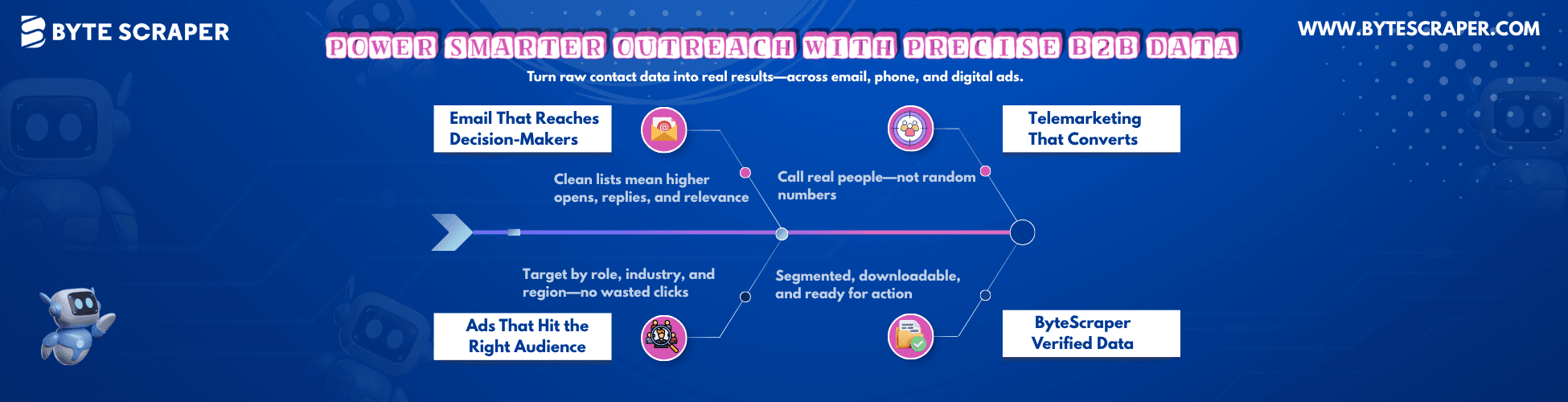
How B2B Data Drives Email Marketing, Telemarketing, and Ads
Discover how accurate B2B data fuels email marketing, telemarketing, and digital ads—boosting outreach, conversions, and ROI with targeted precision
Introduction
If you're executing B2B outreach campaigns, you're likely spending time and dollars on email marketing, telemarketing, and online ads. These are the mediums where connections are ignited and transactions are consummated. But here's what most businesses overlook:
These mediums are only as effective as the data driving them.
Good content, smart timing, and polished creatives won’t drive results if you’re reaching out to the wrong audience—or worse, to no one at all.
That’s where B2B data steps in. Not as a background actor, but as the lead driver of campaign performance.
In this article, we'll discuss how validated, segmented, and targeted B2B data powers your outreach through email, phone, and paid advertising—and how to convert static records into active revenue.
What Do We Mean by B2B Data?
Before we jump into execution, let's get definitive about what type of data drives multichannel B2B marketing:
- Firmographic data: Company size, industry, location, revenue
- Demographic data: Name, title, department, seniority
- Contact data: Email, phone number, LinkedIn profile
- Intent or behavioral indicators: Visits to website, usage of tech stack, downloads of content (optional, advanced level)
Armed with this knowledge, your outreach is no longer cold—it's strategic and effective.
Platforms such as ByteScraper offer downloadable B2B contact databases that are screened by geography, industry, and contact type, enabling marketers to move away from the scattergun tactic and pinpoint exactly the people who matter.
How B2B Data Supercharges Email Marketing
Email Is Useless Without the Right Recipient
Let’s start with email—the most popular and measurable outbound B2B channel. Even today, email returns $36 for every $1 spent (DMA 2024). But that’s only if your data is clean.
Poor B2B data means:
- Bounced emails
- Low open rates
- Spam flags
- Wasted automation sequences
High-quality data ensures you’re landing in real inboxes, reaching actual decision-makers, and matching the message to the recipient.
What Accurate B2B Data Enables in Email:
- Personalized emails with correct names, roles, and companies
- Segmentation by company size, geography, or job function
- Dynamic content by industry or vertical
- Improved deliverability and sender reputation
Think about being able to send emails to 100+ employee manufacturers in the Midwest—rather than "Dear IT department."
Pro Tip:
Utilize tools like ByteScraper to scrape verified data sources such as Medical Clinics in California or Insurance Brokers in Florida, and import them straight into your email platform for more targeted outreach.

Telemarketing That Works: It Begins With Verified Phone Data
Telemarketing may seem archaic, but it's still a mighty channel—particularly when coupled with reliable data.
Cold calling does not fail because individuals dislike telephones, but rather because most cold calls are irrelevant or poorly targeted.
With Accurate B2B Phone Data, You Can:
- Connect with the real decision-maker (rather than receptionists or default staff)
- Schedule calls based on business location (timezone targeting)
- Get ready with pre-call research (company size, niche, website)
- Lower no-answer rates and dead-end dials
Let's Be Clear:
An uncontexted phone number is noise.
A job title, company size, and vertical assigned to a phone number? That's value.
ByteScraper's filtered datasets frequently contain phone numbers broken out by industry and geography—ideal for reaching out to Texas contractors or New York dentists.
Cold Calling Becomes Warm Outreach
When you’re calling “Sarah, Practice Manager at Midtown Dental,” rather than a random “Business Owner,” the quality of the conversation—and your chance of closing—increases drastically.
Paid Ads: How B2B Data Drives Better Targeting and Retargeting
Digital advertising in B2B gets tricky. Unlike B2C, you’re not just targeting “age + gender + interest.” You’re targeting professionals with specific pain points, responsibilities, and buying power.
How B2B Data Improves Ad Performance:
- Custom Audience Uploads: Upload email lists to LinkedIn, Facebook, or Google to reach verified decision-makers.
- Account-Based Retargeting: Target visitors from target companies by matching cookies or IPs.
- Geo-Targeting + Industry Focus: Target ads only to users in your most important regions and industries.
- Lead Form Optimization: Pre-populate forms using known company or contact information.
With good data, your Cost Per Lead (CPL) decreases, and your Conversion Rate (CVR) increases—because your message is revealed only to people who are likely to care.
Real-World Use Case: ByteScraper for Multichannel Campaigns
Suppose your team is promoting a marketing automation solution for small dental clinics in California.
Here's how ByteScraper assists you in executing:
Step 1: Data Collection
- Download a list of California-based medical or dental clinics filtered by relevance.
- Collect full names, job titles (for example, clinic managers, office admins), emails, and phone numbers.
Step 2: Email Campaign
- Segment by clinic location and size.
- Craft subject lines such as: "Helping small LA clinics save admin time."
Step 3: Cold Calling Follow-up
- Make calls during local business hours.
- Apply learnings from the dataset to craft personalized intros.
Step 4: LinkedIn and Meta Ads
- Upload contact list to build a custom audience.
- Display carousel ads featuring time-saving features for practice management.
Step 5: Track and Optimize
- Track email opens, call success, and ad CTR.
- Optimize your dataset monthly for better ROI.
With the right B2B data, each step of the journey is data-driven, not made-up.
Steer Clear of These Common Data Blunders Across All Channels
Let's face it. Most failed campaigns by marketers are due to the fact that they used low-quality or stale data.
Red Flags to Watch Out For:
- Bought "bulk" email lists with no segmentation
- Phone numbers in the absence of job titles or business context
- Email addresses with excessive bounce rates
- Free scraping tool contacts that have not been verified
- Static data that has not seen an update for 12+ months
Always go with platforms that emphasize verification, segmentation, and transparency.
ByteScraper updates its databases regularly, provides multiple contact formats, and even custom scrapes for niche applications.
What to Look for in a Data Provider for Omnichannel Marketing
Here's your mini-checklist:
| Feature | Why It Matters |
| Verified email & phone | Enhances reach & deliverability |
| Role-based targeting | Facilitates relevance in messaging |
| Industry filters | Merges with your vertical interest |
| Location segmentation | Essential for timezone-based outreach |
| Export formats (CSV/XLSX) | Simple to import into tools |
| CRM compatibility | Syncs with your marketing infrastructure |
| Regular updates | Keeps campaigns contemporary and accurate |
| Custom list building | For sophisticated or specialty outreach |
ByteScraper ticks all these boxes, making it one of the simplest ways to convert B2B data into marketing traction.
Final Thoughts: Don't Guess—Target
Multichannel marketing today is no longer a volume game. It’s a relevant game.
You’re not rewarded for sending 10,000 emails or buying 50,000 impressions. You’re rewarded for connecting with 500 people who genuinely need your solution.
B2B data transforms marketing from guesswork to targeted efforts.
Platforms like ByteScraper empower teams to move quickly, without sacrificing precision.
So, if your email campaigns are underperforming, your cold calls aren’t converting, or your ads are burning through your budget…
It's most likely not your team.
It's your data.
It's time to get it done.