
Business Intelligence vs. Business Data: How They Work Together for Smarter Decisions
Discover the real difference between business data and business intelligence—how they work together, why clean data matters, and how ByteScraper helps turn raw information into smart decisions.
🎯Introduction
In today's digitally oriented business environment, "Business Intelligence" and "Business Data" often become interchangeable, leading to confusion and potentially misinformed business decisions. Although inherently connected, they are different concepts with divergent purposes in enabling organizations to succeed. Understanding their unique features and their synergistic integration is crucial for any business seeking to leverage information for competitive advantage.
At its root, Business Data is the raw material – the pool of facts, figures, and statistics that an organization acquires from its different operations and from outside. It's the business's digital DNA, including everything from sales transactions and customer interactions to website analytics and market research insights. Without this bottom layer of data, Business Intelligence, in its purest sense, cannot exist.
Business Intelligence (BI), however, is the art of transforming raw data into actionable insights. It involves applying tools, technologies, and methods to gather, consolidate, analyze, and report business information, enabling improved decision-making. BI is the catalyst that pulls meaning out of the vast sea of business information and delivers context and knowledge to facilitate strategic initiatives and reach organizational objectives.
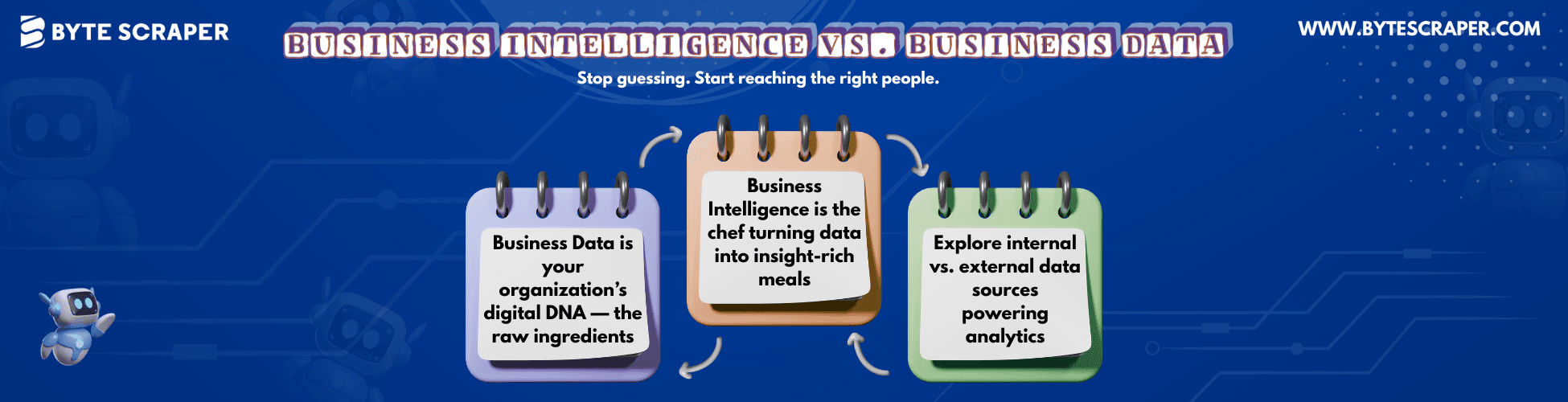
🍳 Consider it in the following terms: Business Data is the raw ingredients in a kitchen – the sugar, flour, eggs, and spices. Business Intelligence is the chef, the recipes, and the cooking process that takes these raw ingredients and turns them into a savory and healthy meal. The quality of the ingredients (data) directly determines the quality of the finished dish (insights).
🧩 What Is Business Data?
Business data is the raw stuff—the building blocks. It’s every sales record, every customer click, every support call, every market trend report. It’s internal data from your CRM, ERP, POS, and website analytics. It’s also external data—like industry benchmarks, competitor insights, or firmographics scraped from third-party platforms.
In short, it’s your company’s digital DNA.
But by itself? It’s just noise.
🍳 What Is Business Intelligence (BI)?
BI is what makes the noise meaningful.
It’s the process (and tech) that takes all those scattered pieces of information and turns them into something useful. Something visual. Something strategic. Something you can act on.
Think of it this way:
Business data is like raw ingredients in a kitchen—flour, sugar, spices, eggs.
BI is the chef, the recipe, and the cooking process that turns those ingredients into a Michelin-star meal.
If the ingredients are stale, no recipe will save the dish. But with the right data and a skilled BI setup? You’ve got a recipe for growth.
🏗️ Where Business Data Comes From
Here’s a closer look at the typical data sources most businesses rely on:
🔁 Internal Data Sources:
- CRM systems: Track customer interactions and sales activity
- ERP platforms: Store supply chain, inventory, and finance data
- POS systems: Capture transactions and purchase trends
- Web & app databases: Record visitor behavior and engagement metrics
🌐 External Data Sources:
- Market research: Understand industry movements and competitors
- Public and government data: Monitor economic signals
- Social listening tools: Capture customer sentiment and brand reputation
- Third-party vendors (like ByteScraper): Access verified B2B contacts, firmographics, and insights
But let’s be real—these sources don’t always play nice. You’ve got inconsistent formats, duplicate records, and missing fields. It’s like opening a pantry and finding ingredients thrown everywhere. That’s where BI comes in.
📈 What BI Does with the Data
Business intelligence takes the chaos and makes sense of it. Here's what it actually does:
🏛️ Collects & Organizes:
- Pulls data into one warehouse
- Cleans, deduplicates, and standardizes everything
🔍 Analyzes:
- Descriptive Analytics: What happened?
- Diagnostic Analytics: Why did it happen?
- Predictive Analytics: What’s likely to happen next?
- Prescriptive Analytics: What should we do about it?
📊 Visualizes:
- Dashboards, charts, trend lines—simple visuals for complex ideas
🔧 Uses Tools Like:
- Tableau, Power BI, Looker, or even custom dashboards
But here’s the kicker…
Even the best BI tools are useless if the data going in is dirty.
Garbage in = garbage out.
🔗 Why BI and Data Can’t Exist Without Each Other
They’re two sides of the same coin.
- You can’t build insights without reliable data.
- And you can’t make data useful without BI.
- One without the other is just wasted potential.
You don’t need “more data.”
You need the right data—structured, relevant, and clean.
🧠 How ByteScraper Powers Smarter BI in B2B
This is where ByteScraper changes the game.
We specialize in clean, structured, ready-to-plug-in B2B data—designed to feed BI tools and fuel strategic decisions.
✅ What We Deliver:
- Filtered datasets by industry, employee size, revenue, and region
- Verified business emails, phone numbers, websites, and social media links
- Segment-ready lists for direct upload into your CRM or analytics tool
🧵 Real Example:
A marketing firm in Australia wanted to target HR heads at textile companies in Sydney. Using ByteScraper, they filtered a verified list of 3,200 companies with precise contact and industry details.
The result? Their team launched a LinkedIn campaign that hit 92% match rate—and generated 4x more leads than their previous outreach.
That’s the kind of difference clean data makes.
Where a Screenshot Helps
- Byte Scraper’s interface showing filters (location, industry, headcount)
- A sample record: company name, email, phone, website, contact title, etc.

🔚 Final Thoughts: Data Is the Fuel. Intelligence Is the Engine.
To run a high-performing business in today's world, you need both.
- Business data is the fuel.
- Business intelligence is the engine.
- And clean data? That’s high-octane.
🚀 Let ByteScraper give your BI engine the power it deserves.
✅ Want a sample dataset to test your BI workflow?
Get in touch → We’ll send you a tailored sample list based on your industry and goals—no fluff—just clean, usable data.